

An EPOS system is defined as an electronic point of sale solution that combines hardware, software, and cloud connectivity to manage sales, stock, and reporting in real time. A traditional POS system, by contrast, processes transactions through standalone hardware with limited or no software integration. Understanding what is EPOS vs traditional POS is the single most important decision a VAT-registered UK retailer or hospitality operator will make in 2026. HMRC’s Making Tax Digital (MTD) programme requires digital records and digital links for VAT reporting, and that requirement alone is pushing thousands of businesses to reconsider their current setup. This guide explains the operational, financial, and compliance differences so you can choose with confidence.
How do EPOS and traditional POS systems work differently?
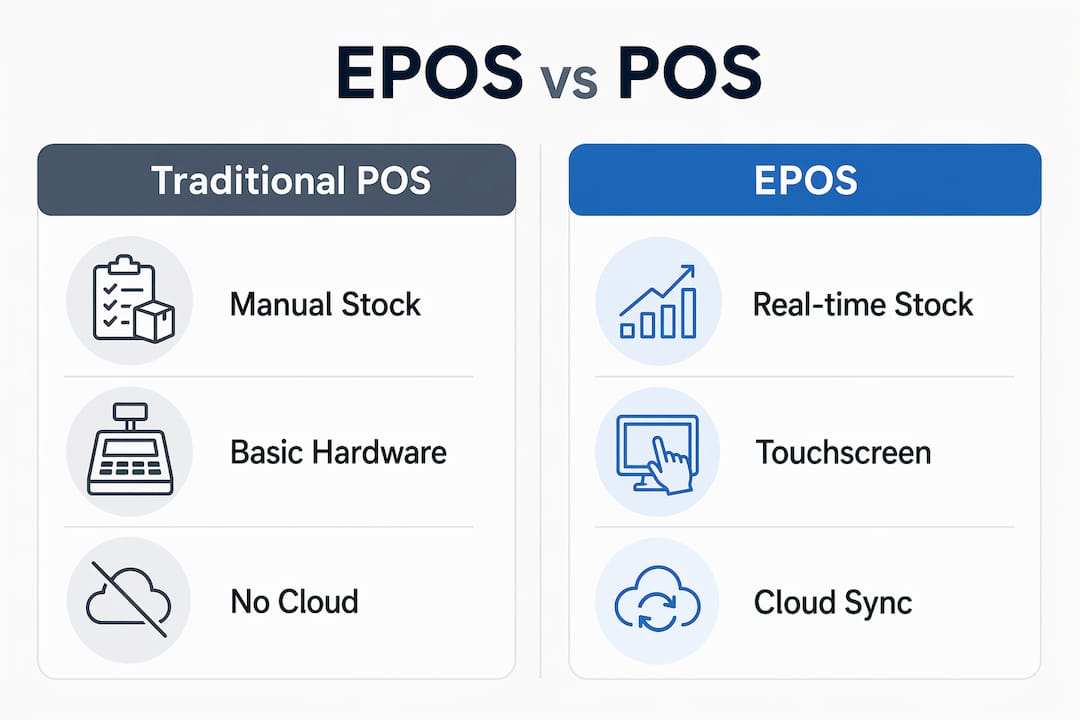
Traditional POS hardware typically consists of a cash register or basic terminal, a receipt printer, and a cash drawer. Sales data stays local. End-of-day reports are printed or manually recorded, and stock counts are done by hand. The system does one job: process a payment.
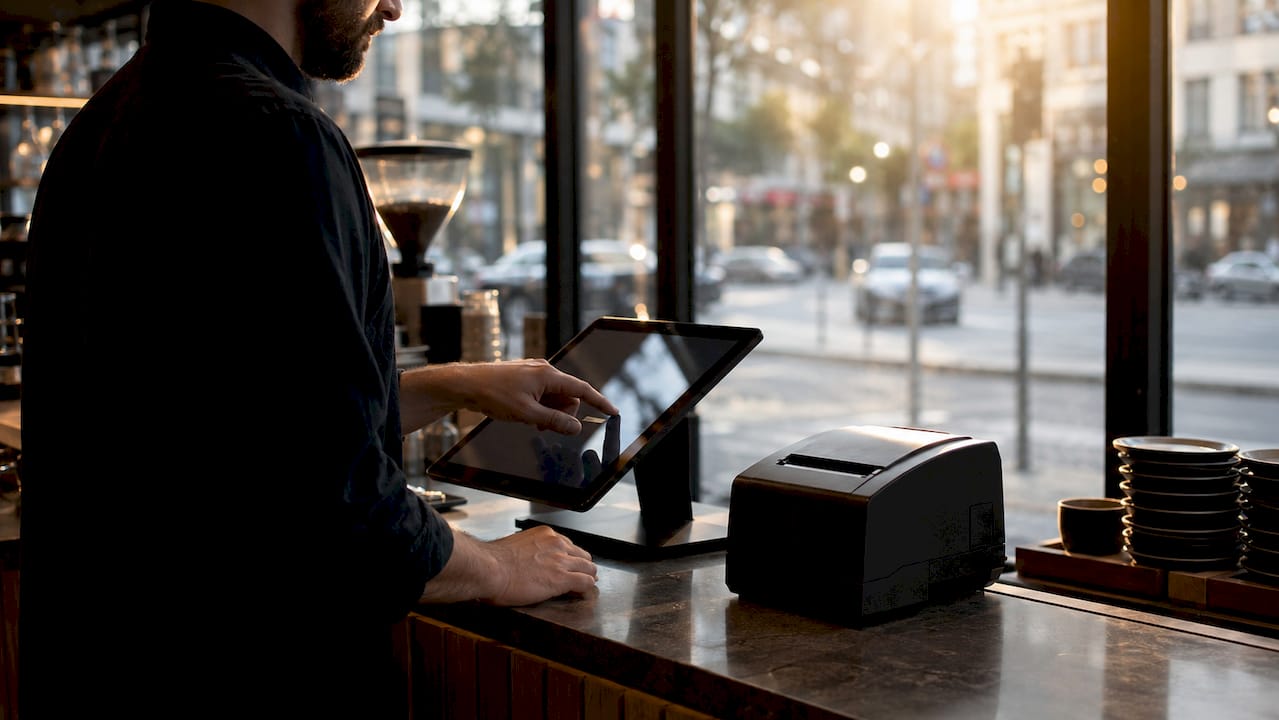
An EPOS system does considerably more. It connects a touchscreen terminal or tablet to cloud-based software, syncing sales, stock levels, and customer data in real time. When a barcode scanner reads a product at the till, the stock count updates instantly across every location. That single action also feeds into sales reports, reorder alerts, and loyalty programme records. EPOS centralises inventory, sales, loyalty, and reporting associated with every transaction, transforming the checkout from a payment tool into a connected business platform.
The table below summarises the core operational differences:
| Feature | Traditional POS | EPOS |
|---|---|---|
| Stock management | Manual counts | Real-time automatic updates |
| Reporting | End-of-day print | Live dashboards, remote access |
| Software updates | Manual or none | Automatic via cloud |
| Multi-location support | Not supported | Centralised control |
| Accounting integration | Manual export | Direct digital links |
| Offline capability | Always offline | Hybrid offline mode with sync |
Pro Tip: Before choosing a system, map every operational task your team performs manually each day. If more than three of those tasks appear in the “Traditional POS” column above, the long-term cost of staying put will exceed the cost of switching.
What are the costs of EPOS versus traditional POS?
Cost is where the comparison gets genuinely nuanced. Traditional POS involves a one-off hardware purchase, which feels straightforward. You buy the till, the printer, and the drawer, and you own them outright. There are no monthly fees, and software updates are either absent or purchased separately.
EPOS pricing works differently. Subscription fees range from £0 per month for entry-level tiers to over £100 per month for enterprise plans, with card processing fees typically sitting in the 2.3%–2.7% range. That recurring cost surprises many business owners who compare only the upfront hardware price. The hardware entry cost for EPOS can actually be lower than a traditional till setup, but the long-term subscription costs change the total ownership calculation significantly.
The factors that shift the balance in favour of EPOS include:
- Automatic software updates included in the subscription, removing the cost of manual upgrades
- Reduced labour costs from automated stock counts and digital reporting
- Fewer reconciliation errors, which carry their own hidden financial cost
- Scalability without purchasing new hardware for each additional location
- Integrated accounting links that remove the need for manual data re-entry
Pro Tip: Calculate your total cost of ownership over three years, not just the upfront price. Include staff time spent on manual stock counts, end-of-day reconciliation, and any accountancy fees tied to manual VAT reporting.
How does EPOS support HMRC MTD compliance?
This is the section most UK business owners wish they had read before their first VAT audit. HMRC requires VAT records to be kept for at least six years with digital links enforced for VAT reporting under Making Tax Digital. A digital link means the data must flow electronically between your POS system and your accounting software, with no manual re-keying permitted in between.
Traditional POS systems fail this test by design. Traditional till records can fail to meet MTD VAT requirements, and many VAT-registered businesses only discover this when they are audited. The problem is not just legal risk. Manual re-keying in traditional POS causes reconciliation discrepancies that are often detected only during VAT reporting, by which point correcting them is time-consuming and expensive.
EPOS systems address this directly. The compliance features typically supported include:
| Compliance requirement | EPOS capability |
|---|---|
| Digital VAT records | Stored automatically per transaction |
| Digital links to accounting software | API or direct integration (e.g., Xero, Sage) |
| Six-year record retention | Cloud storage with audit trail |
| Error-free data transfer | No manual re-keying required |
| VAT rate management | Configurable per product category |
Many UK business owners mistakenly assume traditional POS setups comply with HMRC MTD rules. The assumption is understandable, but it is incorrect. If your business is VAT-registered and your till does not connect digitally to your accounting software, you are carrying compliance risk every quarter.
Pro Tip: Ask any EPOS vendor to confirm which accounting platforms they integrate with and whether that integration satisfies HMRC’s digital link requirement. Get the answer in writing before you sign a contract.
What practical benefits does EPOS offer growing retail and hospitality businesses?
The EPOS advantages over traditional POS go well beyond compliance. For a retail shop or hospitality venue planning to grow, the operational gap between the two systems widens with every additional product line, member of staff, or new location.
Real-time inventory is the most immediate benefit. When a customer buys the last unit of a product, the system flags a reorder alert without anyone checking a shelf. For a busy café or convenience store, that automation prevents the lost sales that come from running out of stock unnoticed. Successful restaurant operators select POS systems based on operational fit, not brand recognition, because features like kitchen display integration and bar tab management are what prevent bottlenecks during a busy service.
The practical benefits for retail and hospitality businesses include:
- Centralised multi-location control: manage stock, pricing, and promotions across every site from one dashboard
- Sales analytics: identify your best-selling products, peak trading hours, and underperforming lines without manual spreadsheets
- Customer loyalty programmes: track purchase history and issue rewards automatically at the point of sale
- Mobile and tablet access: manage your business remotely, whether you are on the shop floor or off-site
- Kitchen display system (KDS) integration: for hospitality venues, orders route directly from the till to the kitchen screen, reducing errors and verbal communication
One misconception worth addressing directly: EPOS systems are not dependent on a constant internet connection. Modern EPOS systems provide hybrid offline modes that process data locally and sync later, removing the connectivity concern that once made traditional POS seem more reliable. The offline reliability advantage that traditional systems once held is now largely obsolete.
For businesses thinking about retail technology adoption more broadly, EPOS is the foundation on which every other digital tool, from digital signage to self-service kiosks, is built. Choosing the right POS system for 2026 means choosing a platform that can grow with your business rather than one you will need to replace in two years.
Retail loss prevention is another area where EPOS delivers measurable value. Because every transaction is logged digitally with a staff ID, time stamp, and product record, discrepancies are visible immediately. Retailers interested in a broader approach to loss prevention in retail will find that EPOS data provides the audit trail that supports both internal investigations and insurance claims.
Key takeaways
EPOS is the operationally and legally superior choice for any UK VAT-registered retail or hospitality business that plans to grow, comply with HMRC MTD, and manage stock without manual processes.
| Point | Details |
|---|---|
| EPOS vs traditional POS definition | EPOS integrates hardware, software, and cloud connectivity; traditional POS processes payments only. |
| MTD compliance risk | Traditional POS rarely meets HMRC’s digital link requirement, creating VAT audit exposure. |
| Cost structure difference | Traditional POS has a one-off cost; EPOS uses subscriptions that change the three-year total. |
| Offline reliability | Modern EPOS systems process offline and sync later, removing the traditional POS connectivity advantage. |
| Scalability | EPOS supports multi-location control, live analytics, and loyalty programmes that traditional POS cannot. |
Why I think most businesses switch EPOS too late
The businesses I see struggling most are not the ones that chose EPOS and regretted it. They are the ones that stayed with a traditional till because it “still works,” then faced a VAT audit or a growth moment that exposed every gap in their setup at once.
The compliance angle is the one that catches people off guard. Choosing the right POS depends heavily on features aligned to specific operational needs rather than price, and MTD compliance is an operational need whether you treat it as one or not. I have seen hospitality operators discover mid-audit that their till data cannot be exported in a format HMRC accepts. That is an expensive lesson.
The other mistake is treating EPOS as a technology upgrade rather than a business decision. The question is not “do I need cloud software?” The question is “what does my business need to look like in three years, and does my current till support that?” For most growing retailers and hospitality venues, the honest answer is no. The shift to modern POS systems is not about keeping up with trends. It is about removing the manual processes that quietly cost you money every single week.
— John
Ycr’s EPOS solution for UK retail and hospitality
Ycr has supplied POS hardware and software to UK retailers and hospitality businesses for over three decades. For operators ready to move from a traditional till to a fully integrated EPOS setup, Touchpoint Software is a purpose-built solution covering sales, stock management, VAT-compliant reporting, and accounting integration in one platform.
Touchpoint is designed for the operational realities of UK retail and hospitality, including multi-location management, kitchen display integration, and the digital links required under HMRC’s Making Tax Digital. Ycr offers same-day dispatch and next-day delivery on hardware, with credit accounts available for qualifying businesses. Contact the Ycr team to discuss which configuration fits your current setup and your growth plans.
FAQ
What is the main difference between EPOS and traditional POS?
A traditional POS processes payments through standalone hardware with no software integration. An EPOS system connects hardware to cloud software, enabling real-time stock management, digital reporting, and accounting integration.
Does a traditional POS system comply with HMRC Making Tax Digital?
Traditional POS systems rarely meet MTD requirements because they cannot create the digital links between sales data and accounting software that HMRC mandates for VAT-registered businesses.
Is EPOS reliable without an internet connection?
Modern EPOS systems include hybrid offline modes that process transactions locally and sync data once connectivity is restored, making them as reliable as traditional POS in low-connectivity environments.
How much does an EPOS system cost compared to a traditional till?
Traditional POS involves a one-off hardware purchase, while EPOS uses a subscription model ranging from entry-level plans to over £100 per month for enterprise tiers, plus card processing fees of approximately 2.3%–2.7%.
What is the best POS for retailers planning to expand?
EPOS is the better choice for any retailer planning to open additional locations, because it provides centralised stock control, live sales analytics, and multi-site management from a single platform.